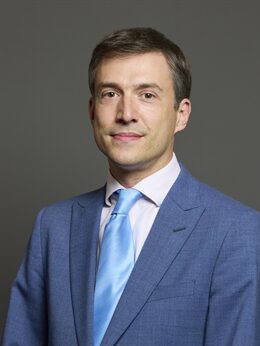
Member of Parliament
Adrian Ramsay MP
Green Party
- MP for Waveney Valley
Adrian Ramsay is the Green Party MP for Waveney Valley. Adrian Ramsay is one of the Green Party MPs who have publicly rejected the party's "Zionism is Racism" motion.
Publicly rejected the motion
Green councillors and MPs are asked to sign the pledge: that Zionism is not racism, that they do not support the motion, and that they will treat antisemitism as racism. The pledge and who has signed.
On BBC Newscast, 31 October 2026
Adrian Ramsay on BBC Newscast: "Is it your view that Zionism is racist?" "No, it's not."
On Saturday 31 October 2026 Adrian Ramsay, the Green MP for Waveney Valley and the party's leader from 2021 to 2025 with Carla Denyer, gave BBC Newscast a long interview with Laura Kuenssberg and Paddy O'Connell on where the party goes after the motion. The Times had reported the day before that the MP would give a BBC interview that weekend, leading Green figures calling for a "conversation about the party's direction". Asked the question the presenters had just played Zack Polanski declining to answer, the MP answered at once. On 1 November the MP posted a clip of that answer on Facebook with the words: "Greens are united in calling out the genocide in Gaza and the ethnic cleansing in the West Bank. Green MPs are among the strongest forces in Parliament pressing our Government to do more. I also stand by our 2024 manifesto position supporting equal rights and self-determination for Palestinians and Israelis."
What the MP says
"Is it your view that Zionism is racist?" "No, it's not."
At 15:30 the presenter puts the question the party's leader had twice declined to answer in the same studio, in the recording played just before. The MP answers at once: "No, it's not. And I've made clear my position on the motion, as lots of other Greens have done."
"So Israel does have a right to exist in your view?" "Yes, of course."
At 17:08. The presenter adds that Zack Polanski "doesn't answer that question with a clear yes in the way that Adrian just has". The motion commits the party to "a single democratic Palestinian State in all of historic Palestine".
Parts of the motion "simply wrong in principle"
The MP says "there were some clear statements in this motion that were simply wrong in principle", and grounds that in the party's 2024 manifesto, on which the MP was elected: "equal rights for both Palestinians and Israelis", and "self-determination for all people... Both those people should have a right to statehood". The MP is "deeply uncomfortable with the conference motion that was adopted, as a number of other Greens have said".
Gaza and the West Bank: where the MP agrees with the leader
Before answering, the MP sets out the common ground "with not just Zack, but with the vast majority of Green Party members": what is happening in Gaza is "appalling", "The UN has described it as a genocide", there is "ethnic cleansing happening in the West Bank", and the government "could be doing far more". Those are the MP's words, and the Facebook post of 1 November repeats them. In this campaign's view they make the point: a Green can hold every one of those positions and still say, plainly, that Zionism is not racism.
The leader "should have been there"
Pressed on the leader's absence from the vote: "I was clear at the time, and I have said to Zack directly that I do think he should have been there, and he should have expressed his view clearly." The MP is "not calling for Zack to stand down. This is not a leadership bid."
Rules "clearly designed for a party that was a lot smaller"
Asked whether the party's rules are outdated: "Yes, and I think nearly anyone in the party would say that." A system where "any party member could turn up to conference to vote" no longer ensures "that the ordinary grassroots of the party are getting to have their say". The MP wants "some action in relation to the motion" before the spring 2027 conference, to which a working group on party structures is to bring proposals. The presenters put it that Zack Polanski has suggested the motion "might go on until 2028".
A "small number of people" from the hard left
The MP says many new members are long-standing supporters, but that "a small number of people who've joined who are perhaps from the more very hard left of politics, might be more at home in the SWP or with George Galloway or with Your Party", with "a very different culture", are "seeking to change the direction of the party". Asked whether that is entryism, the MP says a party grown from 60,000 to 200,000 members cannot be called that as a whole, and is "not talking about people like Mothin Ali", the deputy leader, "or other Muslim members", objecting to articles in parts of the right-wing media that have set pictures of Muslim Greens beside that word.
Read the transcript
An automatic transcript of the interview, from 7:25 to about 33:20 of the episode, corrected for names (Ramsay, Zack Polanski, Ellie Chowns, Siân Berry, Mothin Ali). The presenters are Laura Kuenssberg and Paddy O'Connell; the transcript does not show which of them asks each question, so each is marked "Presenter". The times are approximate. The opening seven minutes, in which the presenters set out the story, and the closing items on other subjects are not transcribed. The video is above, so you can check every word against it.
7:25 Presenter: So let's get on then with our conversation with Adrian Ramsay. Adrian, hello, I think you can hear us now.
7:30 Adrian Ramsay MP: Hello.
7:31 Presenter: Good to have you with us. Now, before we get into the guts of sort of what's going on right now and how you've got yourself to this position, I just wondered, it's interesting, we actually first interviewed you a long time ago when you were a local councillor in Norwich, part of building the party, maybe quite gradually, but getting, you know, a toe hold, then a foot hold, then being able to make strides forward in local government. Did you want to just give us a bit of context about how, you know, what your experience has been like as being part of building the Greens? Because, as Paddy said, you joined in 1998.
8:05 Adrian Ramsay MP: I did indeed, and I was a teenager then, for clarity. And I joined because I felt, having learned about issues like climate change, like deforestation, as a teenager, and just becoming deeply concerned about the state of our environment. You know, even back then, I felt these issues are really urgent, and they're not just ones to learn about to pass an exam. They really need to be tackled or they'll have a big impact on people in the UK and around the world in our lifetime, in my lifetime. And of course, in the time since then, these issues have only become even more urgent, even more pressing. And so, both through things I've done in politics, but also through the 10 years I spent leading national environmental charities, I have focused my career, my campaigning, my work as a councillor and now as an MP, and previously in leadership roles in the Green Party, on really trying to make as much of a difference as I can, working with colleagues, working with the wider movement, working with charities, to really drive forward the solutions that we need to see. And of course, the hard truth is that the sorts of things I'm talking about in Parliament now, in debates I've led in recent months, are about those impacts that are now happening, about the fact that we've had a summer of extreme heat, of wildfires, of droughts, that we've got, we're expecting real problems with storms and floods this winter. So the action has never been more urgent, and yeah, that's what I have dedicated my focus to.
9:38 Presenter: And just because we know all political parties who come on here, they care passionately about their causes. And just one of the things I just want to get quickly from you, Laura asked you to go back in time to 1998. It's quite important to say, isn't it, that that's just a year after the massive landslide by the Labour Party. So as a teenager, you are positioning yourself to the left of the Labour Party. So you're, of all the people who are currently Green, they would consider that they want to be further left than the Labour Party. Would you concede that as a teenager you wanted more left in British politics than was being offered by the Labour Party?
10:12 Adrian Ramsay MP: Certainly. If you look at the way the Blair government came in, I wanted a more progressive form of politics, and first and foremost, I wanted environmental justice at home and abroad to be central to that. But yes, also action to tackle poverty, to make sure...
10:31 Presenter: But you're to the left of Tony Blair. You wanted to be to the left of Tony Blair is what I mean, quickly.
10:36 Adrian Ramsay MP: Yeah, yes. Yes.
10:38 Presenter: Then you became leader, co-leader with Carla Denyer, who's one of the Bristol MPs, in 2021 and 2025. How would you sort of assess the progress that the party was making in that era? Because it, you know, looking back and compared to what's happened in the last 12 months, it might have been steady, but I think it might, would it be fair to say that it was quite slow?
11:00 Adrian Ramsay MP: Well, you could describe it as that, and we have certainly seen enormous growth in our number of councillors and our membership in the last year, which is extremely welcome and has brought huge energy that we need to carry on building on. But what I would say about the time that Carla and I was co-leaders and the period, the years before that, is we saw, I think it was eight years in a row, where we saw growth in our number of councillors to record levels. We saw Greens winning for the first time in all corners of the country, winning seats from the Conservatives and from Labour in urban and rural areas alike. And I was really proud, and I'm really proud of the fact that we have got Green representation in a record number of Greens, not just as councillors, but actually in leading positions on local councils, having a real impact for their communities, on the environment, on looking after the most vulnerable. And I'm also proud that that has grown even more in the last year.
12:00 Presenter: Could I characterise your position as once he was elected, you could say, I back Zack, and after the motion and his non-appearance at the conference which elected it, your position is now that you don't back Zack in the same way?
12:14 Adrian Ramsay MP: No, that's not fair. And what I want to talk about is where we go as a party after this motion.
12:19 Presenter: So you still back Zack.
12:20 Adrian Ramsay MP: I'm very clear, I am not calling for Zack to stand down. This is not a leadership bid. I've been extremely clear about that. What I want to do is to contribute to a discussion, as other Greens have been doing, around where we go next as a party. And happy to talk about the actual motion and why I think that that does need to be addressed. But most importantly, I think we need to look at how we go forward as a party. And I think if we're going to harness the energy we've built from our growth, huge growth in members over the last year and the election successes we've seen, we've really got to make sure that our core energy and core demands as a party, particularly around climate and nature, but also what that means for the cost of living crisis and for a fair and equal society, we've got to have a real focus on that, particularly because we've had a change of prime minister. There's lots I welcome about Andy Burnham's approach, but we know that he is weak on climate and nature, at a time when the need for us to do far more on these things as a country has never been greater. You know, we've had a government report from the Joint Intelligence Committee this year that says that biodiversity loss and ecosystem collapse are a threat to our national security. This is really severe, alongside the heat waves, wildfires, and droughts that we've seen. So I think we need to make sure we're really clear as a party what our core focus is. I think that will unite our members. I think it will ensure we still have a wide appeal as a party. And so I'm just contributing to a debate around where we go next and how we harness that energy that we've seen.
13:50 Presenter: Let's get into that debate then, because it is a big moment for the Green Party. This motion was voted on. It went through at conference. Lots of people were dismayed by it. One of your colleagues, Ellie Chowns, said there was a clear lack of leadership. It suggested the party might be vulnerable to capture by extremists and racists. Siân Berry, another one of your colleagues, said the motion has done genuine damage to the party's reputation. Caroline Lucas, another former prominent leader like yourself, was also publicly very, very unhappy about what happened. Before we come to what happens next, I just want to play everybody Zack Polanski's own explanation of the motion and why he told us, in his view, it was not controversial.
14:33 Zack Polanski (recording): What's controversial is that 75,000 Palestinians have been murdered in the last few years, including more child amputees than ever in modern history. So when you take that to account, the fact that they're being murdered because they're Palestinian, that's very obviously a racist ideology.
14:50 Presenter (recording): You don't think it's controversial to say that Zionism is racist?
14:52 Zack Polanski (recording): As I say, I think the controversial thing is that Western governments across the world have turned away while Palestinians have been murdered because they're Palestinian. That's very clearly racist. That's quite obvious.
15:03 Presenter (recording): And everyone listening will hear that I asked you a question about your belief of Zionism, and you immediately answered talking about something else, which many people have watched around the world and been absolutely horrified by. I am asking, is it your view as the Green Party leader that Zionism itself is inherently racist?
15:20 Zack Polanski (recording): Well, the reason why I'm answering that question is because rather than have a debate about semantics, it's about the practical application.
15:30 Presenter: Adrian Ramsay, is it your view that Zionism is racist?
15:33 Adrian Ramsay MP: No, it's not. And I've made clear my position on the motion, as lots of other Greens have done. First of all, can I make clear, though, where I agree with not just Zack, but with the vast majority of Green Party members, and I'm sure the vast majority of the British public, that what's happening in Gaza is appalling. The UN has described it as a genocide. We're seeing ethnic cleansing happening in the West Bank. People living in terrible conditions throughout the Gaza Strip because they've been displaced, because they don't have sanitation, they don't have aid, living in rodent-infested camps. This is an appalling situation, which our government could be doing far more on still, even beyond the statements that Ed Miliband's made, which were welcome and Green MPs pushed him into making. They could do far more to make sure that we're not, as the UK, sharing military intelligence with Israel, that we're not selling any arms parts to Israel, the Israeli government.
16:26 Adrian Ramsay MP: So that's really clear. At the same time, I also believe that there were some clear statements in this motion that were simply wrong in principle. And why do I say that? Well, I was elected on the Green Party's 2024 manifesto, which made clear how we are calling out the genocide in Gaza and want our government to be much stronger on that. But it also made clear that we support equal rights for both Palestinians and Israelis. And Greens have always supported self-determination for all people. So as Zack himself has said, it should not be for people in the UK, whether it's in the Green Party or elsewhere, to be dictating what the solution looks like for people in Israel and Palestine. Both those people should have a right to statehood, and that's right to self-determination has always been a Green principle that I stand by.
17:08 Presenter: So Israel does have a right to exist in your view?
17:10 Adrian Ramsay MP: Yes, of course.
17:11 Presenter: And Zack Polanski, just to jump in, because Zack Polanski doesn't answer that question with a clear yes in the way that Adrian just has. So just, that's the reason I'm asking that question, because we've illustrated there that Adrian does, you do have distinct differences with where Zack Polanski positions himself on these controversial issues.
17:28 Adrian Ramsay MP: Well, if Zack set out his position, he's made clear that he would not have voted for the version of this motion that went through our conference. But yeah, I've made my position clear, and I've made clear that I'm deeply uncomfortable with the conference motion that was adopted, as a number of other Greens have said.
17:45 Presenter: And are you also deeply uncomfortable that your leader wasn't there?
17:48 Adrian Ramsay MP: Well, look, that was discussed a lot at the conference.
17:50 Presenter: Are you uncomfortable about whoever's discussed it? You're kindly on our newscast. Can you answer the question if you're happy that Zack Polanski, the leader of the Green Party, was not there when this motion was passed? Is that good?
18:00 Adrian Ramsay MP: I was clear at the time, and I have said to Zack directly that I do think he should have been there, and he should have expressed his view clearly.
18:27 Presenter: Do you think that the Green Party's structures and rules are outdated? You have been part of a big growth in your party, for which you're rightly happy. We know how much you care about this since you were a teenager. But do you think that as you've grown in significance, as cultures changed and everything else, do you think that your rules, your rules on membership, your rules on how motions are carried and what weight they carry, are outdated?
18:50 Adrian Ramsay MP: Yes, and I think nearly anyone in the party would say that, because those processes were clearly designed for a party that was a lot smaller. And they were also designed for the traditions of the Green Party, which in the past has been a party that has not been highly factional or highly tribal. And, you know, we have seen elements of that starting to happen, you could argue perhaps inevitably, as the party's got bigger. So we need to make sure we're safeguarding the democracy of the party. We've always been strong on that. When we were a much smaller party, maybe a system where any party member could turn up to conference to vote worked. But I think now it's not one where we're ensuring that the ordinary grassroots of the party are getting to have their say.
19:35 Presenter: How important is it to you, Adrian, that this motion is either changed or struck down? And if it's not, if nothing changes, and if, as Zack Polanski suggests, this might go on until 2028, is it right that he stays on as leader if this stays in place?
19:52 Adrian Ramsay MP: Look, I think, of course, it's important to me. I would highlight that our 2024 manifesto is the basis on which I was elected, and I'm sticking to that in terms of how I operate as an MP. But I think the question here is around how Zack responds to this, and not just Zack, but how the party as a whole responds to this, and where we go next. I think there's a real crossroads point for the party at the moment. And one option is to sort of dig in more down this approach, not only in relation to this motion, but I think that there's a risk it brings with it a quite divisive, quite internally focused approach to politics, which you've perhaps seen from small groups of people on the hard left of politics who go around different parties, try to influence how those parties are run. What I want to see is the party really focus back in on our core aims as a party and our core values, which include making sure that we are consensus-building in how we approach our politics, that we engage the grassroots of our membership. We need to make sure the membership as a whole feels involved, and that we're very externally focused, because we're only going to be able to bring the environmental changes that we need to have to safeguard our society for now and for the future if the majority of the British public come behind that. And that's the sort of Green Party that I want to see.
21:20 Presenter: But if Zack Polanski digs in to what you describe as a divisive politics, would you be able to continue supporting him as the Green Party leader if he doesn't act?
21:30 Adrian Ramsay MP: Look, I've got no intention of going anywhere. What I want to see happen is this issue be clearly addressed. And I think that there's every way of doing that. If you look at where Zack's been his strongest over the last year and before he was leader, it's when he's really used his clearly very strong communication and motivational skills to talk about the fact that we've got a cost of living crisis in this country, that it's inherently linked to the environmental crises that we face. And Zack called on the government to hold a COBRA meeting over the wildfires that happened in the summer, which Andy Burnham did then do. Those are the sorts of ways in which we need to really be leading the country and regaining people's imagination. And I think that that and the strong position the Green MPs have on Israel and Palestine will unite not just party members, but the public who are seeking to get behind us.
22:25 Presenter: Forgive me for pressing you on this. You clearly think, though, there is a lot of jeopardy here. There is a risk of what you said was divisive politics and digging into what a small group of people are interested in. And after this all, you know, became a massive issue, Zack Polanski did double down. He sat on a chair in our studio and said, "Oh, this isn't even controversial." After senior figures like you had been out there in public saying, "This is really, this could be really damaging. We have to be very, very careful." So if there isn't a shift in the position, and if your suggestions to ask the members or to change the rules are not welcomed by Zack Polanski, will you be able to retain your confidence in him?
23:07 Adrian Ramsay MP: Look, I'm confident that the party leadership absolutely can respond to the issues that we're seeing in front of us. And I and other senior Greens are keen to work with them to make sure that that happens. What we've seen is a huge growth of the party over the last year. Many of the new members that I speak to are people who've supported the Green Party for a long time, support our values, support our ways of working. But there is also a small number of people who've joined who are perhaps from the more very hard left of politics, might be more at home in the SWP or with George Galloway or with Your Party, who not only want to adopt some very hardline positions on certain issues, but have a very different culture to how they go about it.
24:00 Presenter: Can I ask you, would you recognise the use of the word entryism?
24:04 Adrian Ramsay MP: Well, if you've had a party that's gone from 60,000 members to 200,000 members, I don't think you can call that entryism. And that's why I'm keen to emphasise that many new members I speak to are people who've been Green Party supporters for a long time, want to get behind what we're standing for, have seen Zack in the media more, and have seen what we're pushing for, and want to get behind that on the cost of living, on restoring the health service, and on environmental issues. What I do think is that there's a much smaller group of people who quite overtly over the last year have said, you know, "Do we join Your Party?", which frankly has floundered, and they realised they weren't going to get anywhere. Or "Do they join the Green Party?", and have been quite overt about their aims to do that. This is a small number of people seeking to change the direction of the party. And what I want to see from the party leadership is setting out that they reassert the core values and focus and ways of working in the Green Party, which are much more about consensus-building, much less about highly factional, highly tribal politics.
25:00 Presenter: And that is entryism. You've literally just spelt out what is entryism, people who might be more at home in the Socialist Workers' Party or in Your Party. You see a small number of people who've come in with very overt and specific aims. Are you saying those people are not welcome in the Green Party?
25:14 Adrian Ramsay MP: I think, look, anyone is welcome to join the Green Party if they support our aims and they support our ways of working. What I want to see clearly set out, including from the leadership, is what the Green Party stands for and how we're going to operate. And, you know, we've had big growth with the Green Party before. We had a big growth with the Green Party membership under Natalie Bennett. That didn't fundamentally change the way the Green Party works, because we and Natalie at the time were very clear how the Green Party, what the Green Party stands for and how we operate. And I'm absolutely sure that that can happen again. And if I can just make one other point, there have been times when, and I'm not focusing this on the BBC, but when parts of the right-wing media have talked about entryism to the Green Party and have put pictures of our deputy leader, Mothin Ali, or other Muslim Greens against that article, and there's been lethal undertones to those articles, which I find offensive and party members find offensive. And I want to be very clear, I am not talking about people like Mothin Ali, who've been a member of the Green Party for a long time, or other Muslim members. I'm talking about a different group that I have concerns about.
26:18 Presenter: You said the Greens are at a crossroads. For someone who's given so much of their life to green activism, campaigning, and of course, you know, building your career in politics, how grave do you think the risk is to the Greens? You've had this astonishing success in the last year or so, but how serious do you think the risk is right now at this crossroads, as you call it?
26:40 Adrian Ramsay MP: I think it is an important point. It's an important point because there's lots of council administrations talking about how they make sure that they can continue to have the real impact they're having on people's lives, on environmental issues, on local services. And in many cases, that involves cooperating with other parties. And I think whether it's at a local level or a national level, it's important that Greens have a distinctive approach, a bold approach that's needed to tackle a range of issues facing the country, but one that also enables us to work effectively with other parties. And having that wide appeal, including to the public, who we need to be behind us if we're going to have wide support, is clearly crucial for us to be successful.
27:25 Presenter: I think what Laura's getting at, and I want to double down on it as well, and say I can only imagine, given that you joined as a teenager, how much you care about this party. But because podcasters, newscasters are going to give you points for being as sort of bluntly honest and your heart as you can be, it just seems for someone like you, you're trying to say, "The warning lights are flashing, guys, that the ordinary Green membership is clearly at risk of being divided. We need to do something, and we are losing members. Listen to me, do something." Is that kind of what you're saying?
27:55 Adrian Ramsay MP: Well, Paddy, I'm trying to be honest. I'm also trying to be constructive, because I want to make sure that we find a way forward that works for the party. And, you know, I'm deeply proud, as I've said, of the huge growth in councils we've got across the country and the dozens of places where Greens are part of the running of local councils. And I speak to my local councillors in parts of Suffolk and Norfolk doing a brilliant job every day. And they have been concerned about what's happened to the party in recent weeks, and they want to see leading Greens speaking up for what they are confident and I am confident is where the vast bulk of Green Party members stand, wanting to stand for the long-established approach the Green Party takes and for our core values, whilst harnessing the energy of the huge growth in membership that we've had.
28:40 Presenter: And to what extent are you speaking with the sort of knowledge and support of other senior Greens, people like Caroline Lucas and other former leader, your colleagues in Parliament like Ellie Chowns and Siân Berry? Because there have been some suggestions that you are trying to coordinate in order to push Zack Polanski to take another look at all of this. Are you working together? I'm not asking that in a pejorative way and accusing you of conspiracy or being in cahoots, but this is clearly a widespread issue that many experienced Greens have concerns about.
29:20 Adrian Ramsay MP: Yeah, that's a fair question. Look, I'm speaking for myself today. I'm not going to ask anyone to have signed up to everything I've said in trying to give you my opinion.
29:30 Presenter: All right. So you've answered, no, you have answered Laura's direct question. Can I ask a sort of very open question? I feel like I've been barking at you a bit. What's the timescale? In other words, you're someone with a concern. You want a debate in the party. It seems to me to be a fair question for me to say, "Do we wait till '28? Do we go in '26? Do we have this done by the spring of '27?" Have you got a timescale for when you want change, both in the rules, in the membership orders and who gets what, and in this possible motion? Do you have a timescale in mind, Adrian?
30:00 Adrian Ramsay MP: Well, the next party conference is next spring, and I understand the working group that's looking at party structures is planning to bring an initial set of proposals to that conference. I think there's the opportunity to take some action in relation to the motion in the run-up to that conference as well. So that's what I have in mind. And although I am speaking for myself today, obviously I'm talking to colleagues in the party. We're at early stages in terms of looking at where we can go next. But, you know, I don't want to give the impression there's any sort of formalised grouping here. There's just lots of individuals talking to each other, including to the leadership. I've spoken to Zack directly about how I think these issues need to be addressed. And I think the next few months are key.
30:45 Presenter: Adrian Ramsay, thank you so much for joining us this afternoon and talking through all the issues. There has been a very big controversy around this, and it's a fascinating sort of picture of actually how sometimes political parties can grow incredibly quickly, and then success is not always sustained in the way that they might have imagined six months ago. It's a really interesting issue. And Adrian, we're very grateful for your time this afternoon.
31:10 Adrian Ramsay MP: Thank you very much.
31:12 Presenter: And we just say, on the word "picture", that behind you, the rosettes are... can you explain what they are?
31:16 Adrian Ramsay MP: Indeed, yes. I think you had wondered whether they were orange or red rosettes. They're certainly not that. They're pumpkins. Next on my agenda is going out trick-or-treating with my children. And yes, we have got some paper Halloween pumpkins on the wall.
31:30 Presenter: Beautifully done. Happy Halloween.
31:33 Adrian Ramsay MP: Thank you.
31:35 Presenter: Well, that quite clearly throws down the gauntlet to Zack Polanski to act, to do something, to come forward with suggested rule changes about how they get rid of this motion that was voted for at conference, or to conduct a survey or a ballot or something of existing members to try to get a taste of where the actual core of Green Party membership is. I think Adrian Ramsay was trying quite carefully to pick his words, but when he was saying things like, "There's a risk of digging into divisive politics," he very openly talked about entryism and having factions in the Green Party that they didn't used to have. So I think that's really quite significant in what's been a very lively debate.
32:15 Presenter: I was also hearing him halve the timescale of the leader who says this can go till '28. And Adrian's saying, "Well, actually, guys, let's do this by spring '27." I think that's very clear.
32:30 Presenter: Yeah, I think it's very clear that there's a group of, and he says he's not in cahoots with anyone else, but there have obviously been lots of conversations going on at the senior levels of the Green Party. And it seems to me that that is a very clear call for something to be done far before the 2028 timescale that Zack Polanski set out.
In the news
5 news stories naming Adrian Ramsay MP
- Novara Media: Greens for Palestine say party figures want to "subvert the Green party's member-led democracy because they fear a loss of control"; a leadership working group is to report to the spring 2027 conferenceNovara Media
- Adrian Ramsay MP, asked on BBC Newscast whether Zionism is racist: "No, it's not." Does Israel have a right to exist? "Yes, of course."BBC Newscast
- Senior Greens to warn that the party has been taken over by pro-Palestinian activists, as 18,000 members leaveThe Times
- The Green Party's leaders and MPs issue a joint statement after the voteLeft Foot Forward
- Four Green MPs make a last-ditch attempt to stop the motionLeft Foot Forward
At a glance
- Party
- Green Party
- Constituency
- Waveney Valley
- Parliament
- House of Commons
- The campaign
- Publicly rejected the motion
- Official page
- UK Parliament
From the public record: Parliament's published details, and endorsements made on this site. Something wrong? Tell us.